Understanding the Results of Bone Mineral Density Tests: T-score and Z-score
Bone mineral density (BMD) tests are performed to determine whether a patient has osteoporosis or osteopenia, a low bone mass that puts her at risk for osteoporosis. To make this determination, the technologist will calculate the patient's T-score. The World Health Organization (WHO) established the criteria for determining the T-score.
To calculate a patient's T-score, physicians subtract the patient's measured BMD from a BMD reference range of women in their thirties (YN = young normal). Around age 35, bone mass is usually at its peak and fracture risk is at its lowest. This figure is then divided by the standard deviation (SD).
T Score = (BMD - YN) / SD
By determining a patient's T-score, the physician will see whether a woman has or is at risk for osteoporosis:
| T-Score: WHO Criteria for Osteoporosis in Women |
| Normal | BMD > -1.0 below the young adult reference range |
| Low Bone Mass (Osteopenia) | BMD is -1.0 to -2.5 SD below the young adult reference range |
| Osteoporosis | BMD < -2.5 SD below the young adult reference range |
| Severe Osteoporosis | BMD < -2.5 SD below the young adult reference range and the patient has one or more fractures |
As a rule, a patient's fracture risk doubles for every SD (standard deviation) below the young adult reference range. For example, if a patients' T-score is -2 SD, she is at four times greater risk of a fracture than a young woman at peak bone density.
Physicians may also measure a patient's Z-score with a bone mineral density test. The Z-score compares the patient's measured BMD to the average BMD measurement for the patient's age and sex. The Z-score is not used to confirm a diagnosis of osteoporosis because a favorable BMD measurement (compared to the average BMD measurement for the patient's age group) does not mean the patient is not at risk for osteoporosis.
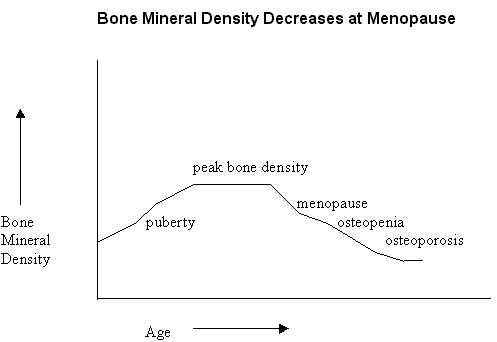
Bone mineral density increases until around age 35 and then levels off until menopause. During the first six to eight years of menopause, there is a sharp decline in bone mineral density. It is estimated that between 1% and 5% of bone density is lost at this time. The higher a woman's overall bone density, the less she will be affected when she loses bone density at menopause.